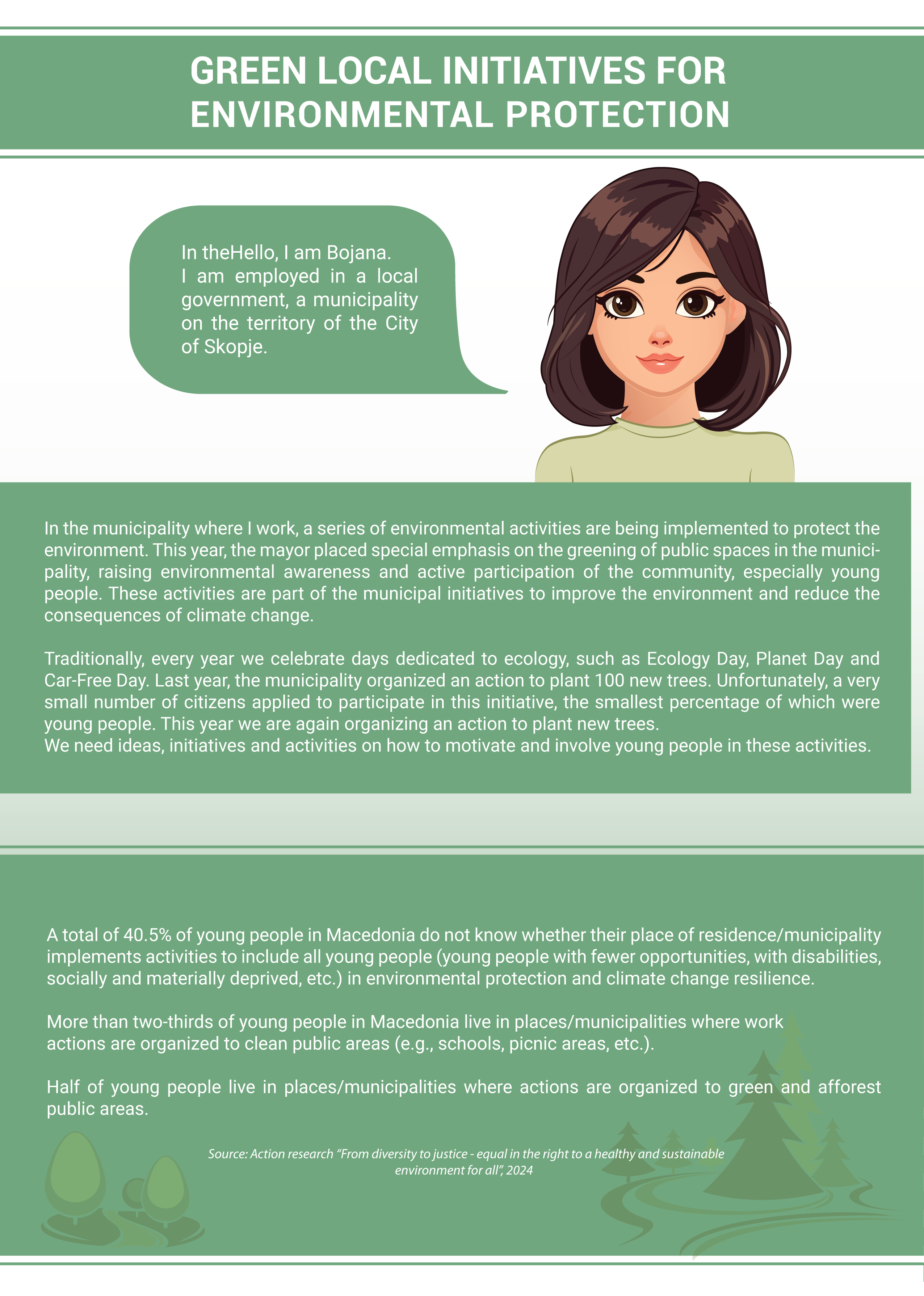
Local green initiatives are essential for a higher-quality environment and more resilient communities. This case study highlights the perspective of an employee from a local self-government unit in a municipality within the City of Skopje, where a range of environmental protection activities are being implemented — with particular emphasis on greening public spaces, raising environmental awareness, and encouraging active community participation, especially among young people.
As part of municipal efforts to reduce the impacts of climate change, days dedicated to ecology — such as Ecology Day, Earth Day, and Car-Free Day — are regularly marked. In the past year, a tree-planting campaign was also organized, but participation — particularly among young people — remained low. This raises an important question: how can local authorities motivate young people to get involved and become drivers of green change?
Data from the action research “From Diversity to Justice – Equal in the Right to a Healthy and Sustainable Environment for All” (2024) show that a significant share of young people do not know whether activities are implemented in their municipality to involve all youth (including young people with fewer opportunities, young people with disabilities, and socially/materially disadvantaged youth). At the same time, many municipalities do organize community clean-up actions and greening and afforestation initiatives — which indicates that the foundation exists, but better approaches are needed to inform and mobilize young people.
The case study also provides concrete, practical ideas on how young people can get involved and contribute, for example through:
- social media campaigns with informative content about the importance of greening and youth participation;
- organizing groups of friends/classmates to jointly participate in actions (tree planting, clean-ups, recycling, clean air initiatives, etc.);
- workshops and presentations on environmental topics in schools and local communities;
- school competitions for the “best idea” for greening, with awards or recognition for active participants.
The message is clear: young people are willing to participate when they have information, space, and a sense that their contribution matters. Local green initiatives can become much stronger when young people are recognized as partners — not just as an audience.
📘 Read the full case study here.
ℹ️ The case study was developed within the project “ZZZ – Joint Green Advocacy for Environmental Protection,” financed by the Government of Switzerland through Civica Mobilitas, implemented by the Macedonian Center for International Cooperation – MCIC, NIRAS Denmark, and FCG Sweden.
The views expressed in this publication are the sole responsibility of the author and do not necessarily reflect the views of the Government of Switzerland, Civica Mobilitas, or the implementing organizations.