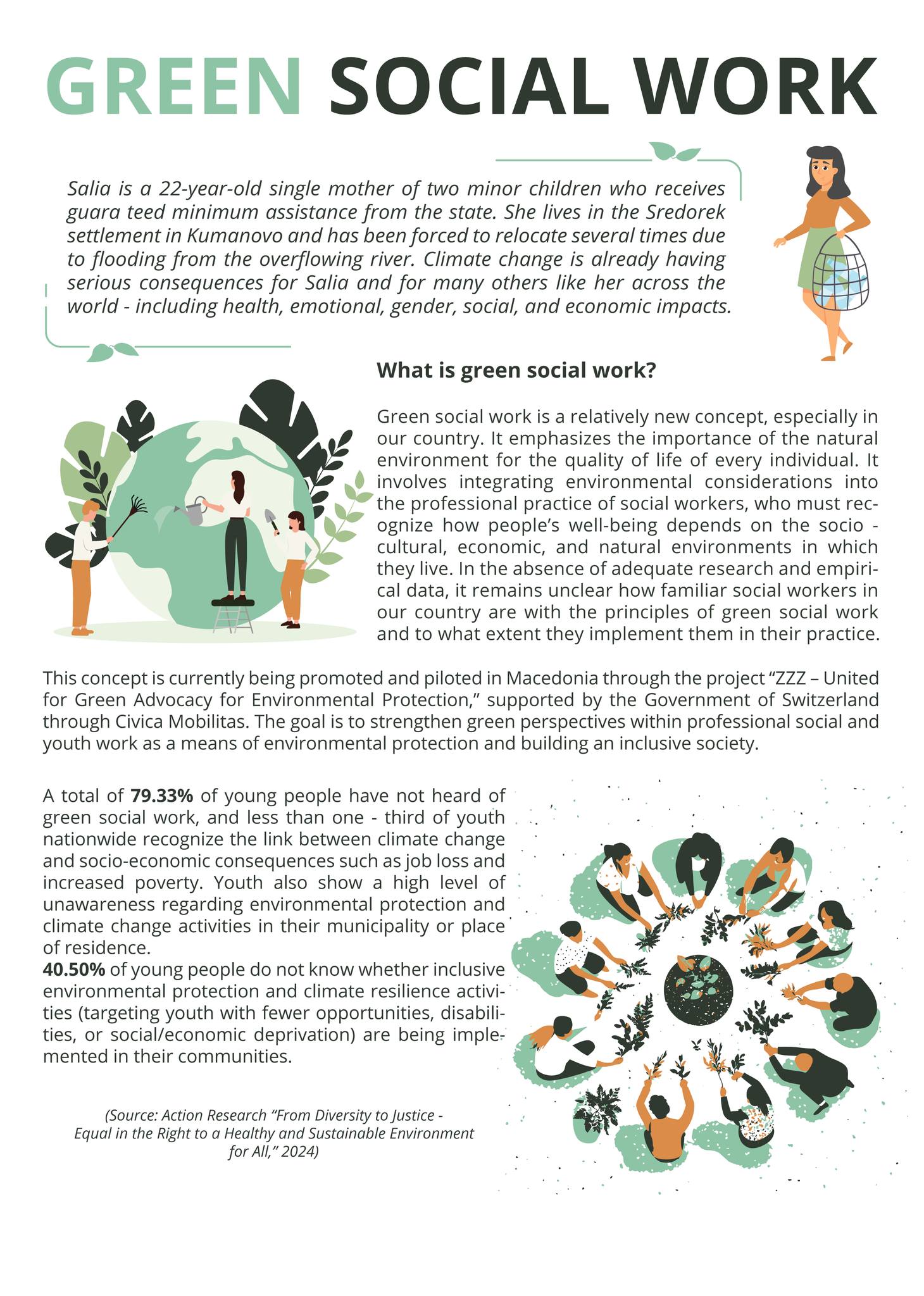
What does green social work represent, and why is it becoming increasingly important in today’s context of climate change?
Green social work is a relatively new concept, especially in North Macedonia, which emphasizes the interconnection between human well-being and the natural environment. It involves integrating environmental issues into the professional practice of social workers, recognizing that quality of life depends on the socio-cultural, economic, and natural environments in which people live.
The results of the action research “From Diversity to Justice – Equal in the Right to a Healthy and Sustainable Environment for All” reveal a high level of lack of awareness among young people. More than two-thirds have never heard of the concept of green social work, and a significant number do not recognize the link between climate change and socio-economic consequences such as job loss and increased poverty.
The study also presents the human dimension of climate change through a concrete example – a young single mother who has been forced to relocate multiple times due to flooding. This case illustrates the direct connection between climate risks and social vulnerability, including health, emotional, gender-related, and economic impacts.
The majority of young people believe that:
- environmental care should be an integral part of social and youth work practices;
- social workers play a key role in protecting and supporting vulnerable groups who are most affected by environmental problems;
- youth workers should have an active role in identifying and addressing environmental concerns in communities;
- green practices can significantly improve young people’s well-being and contribute to building more resilient communities.
The study highlights that creating a supportive environment for environmentally responsible behavior among young people requires a combination of education, practical support, good practice examples, and public policies that encourage and enable green initiatives.
Green social work, as both a concept and a practice, represents an important step toward a more inclusive, fair, and sustainable social development, where environmental protection and social justice are inseparably linked.
📘 The case study is available in four languages – Macedonian, Albanian, Romani, and English.
👉 Read the full case study here
ℹ️ The case study was developed within the project “ZZZ – Together for Green Advocacy for Environmental Protection”, supported by the Government of Switzerland through the Civica Mobilitas program, and implemented by the Center for Youth Activism KRIK, Center for Social Initiatives “Nadez”, and the Association of Social Workers of Macedonia – ZSRM.
The views expressed in this publication are the sole responsibility of the authors and do not necessarily reflect the views of the Government of Switzerland, Civica Mobilitas, or the organizations implementing the program.