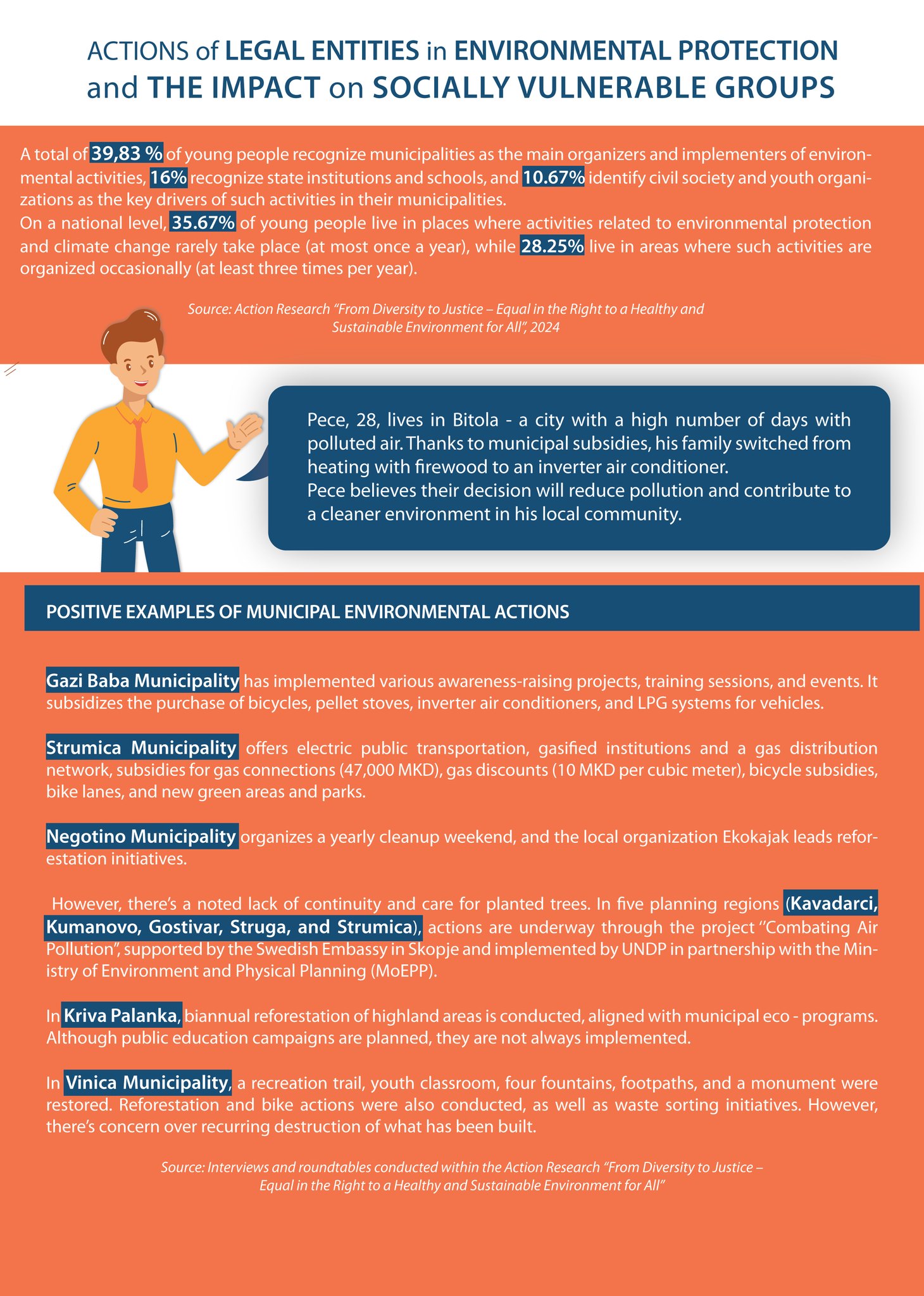
The case study explores the connection between local environmental policies, the actions of municipalities and businesses, and the everyday lives of citizens—especially those who are socially and economically more vulnerable.
Through a concrete example from practice, the study shows how municipal subsidies for changing heating systems can contribute both to reducing pollution and to improving the living conditions of households. At the same time, it points out that environmental activities at the local level are neither frequent enough nor equally accessible in all municipalities, creating inequality in access to a clean and healthy environment.
The study also includes positive examples from several municipalities across the country—such as subsidies for bicycles and more energy-efficient systems, the development of green spaces, and public awareness-raising campaigns. However, it emphasizes that the biggest challenges remain the continuity of these measures, their maintenance, and the involvement of citizens, especially young people and vulnerable groups.
Special emphasis is also placed on the role of businesses, which are increasingly introducing sustainable solutions—from the use of renewable energy sources to improved waste management. Although these practices are encouraging, the study indicates that clearer regulation, better oversight, and greater transparency are needed to ensure a truly fair and effective eco-transformation.
This case study raises important questions about how local policies, economic measures, and institutional responsibility can contribute not only to a cleaner environment, but also to greater social justice and equality.
📘 Read the full case study here.
ℹ️ The case study was developed within the project “ZZZ – Together for Green Advocacy for Environmental Protection”, funded by the Government of Switzerland through the Civica Mobilitas program, and implemented by Center for Youth Activism KRIK, Center for Social Initiatives “Nadez”, and the Association of Social Workers of North Macedonia – ZSRM.
The views expressed in this publication are the sole responsibility of the authors and do not necessarily reflect the views of the Government of Switzerland, Civica Mobilitas, or the organizations implementing the program.