How can more responsible environmental behavior be encouraged?
Through stricter penalties or by rewarding positive ecological practices?
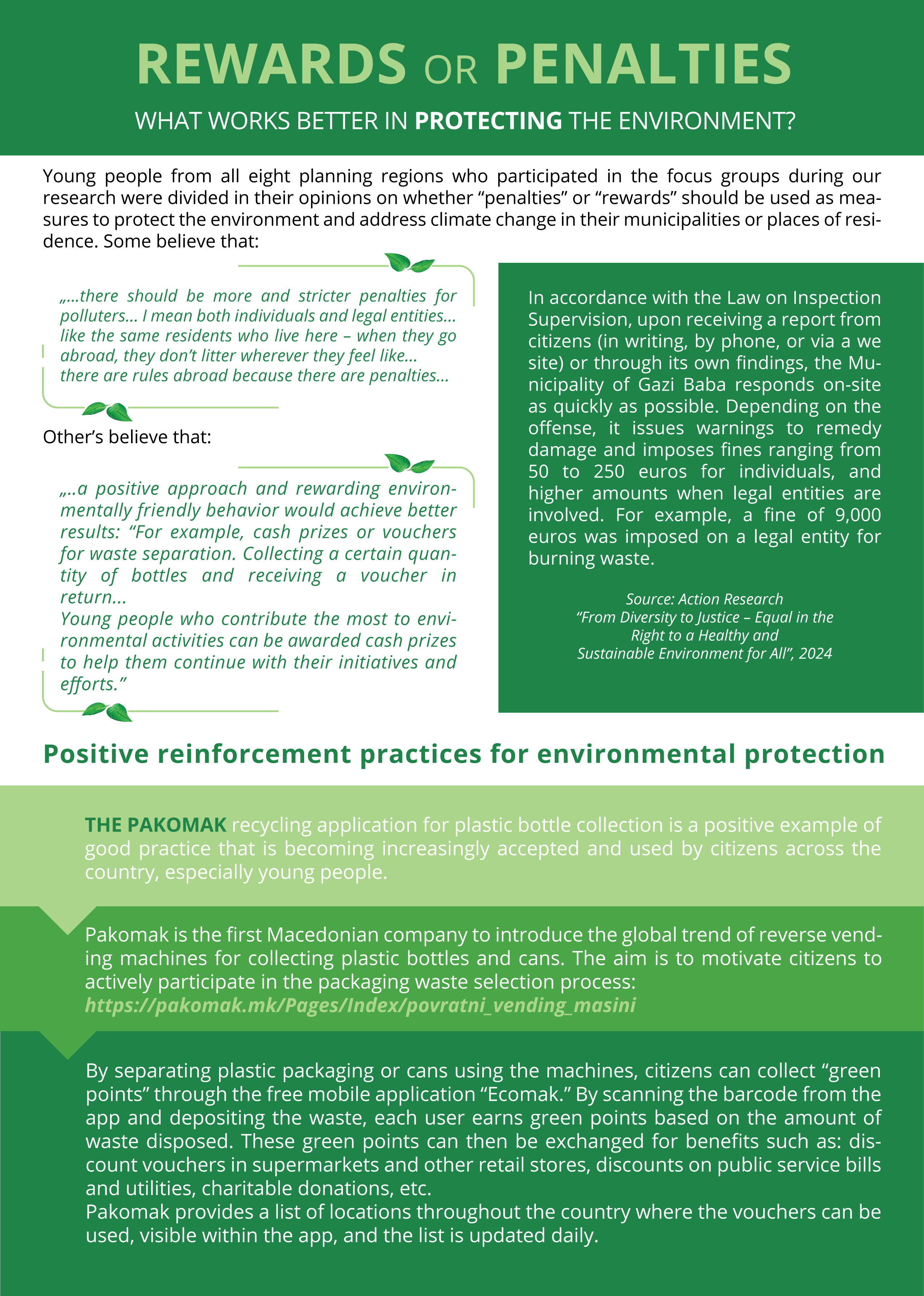
This case study, part of the analysis “From Diversity to Justice – Equal in the Right to a Healthy and Sustainable Environment for All”, opens precisely this dilemma through the experiences and views of young people from all eight planning regions in North Macedonia.
The young people involved in the focus groups are divided in their opinions. Some believe that stricter penalties for polluters—both individuals and legal entities—are necessary to establish order and accountability. They point out that the existence of clear sanctions in other countries contributes to a higher level of environmental culture.
Others, however, believe that a positive approach and rewarding environmentally responsible behavior has a more sustainable, long-term impact. According to them, incentives such as vouchers, points, discounts, or support for eco-initiatives create motivation and a sense of personal responsibility, rather than fear of punishment.
The study also presents existing practices in the country, such as:
- reward systems for waste separation,
- applications and services that encourage recycling,
- mechanisms for reporting and sanctioning pollution at the local level.
Through these examples, the study highlights that the most sustainable solutions are those that combine clear sanctions with well-designed positive incentives, along with transparent and accessible mechanisms for citizen participation.
Rather than offering a simple answer, this case study invites a broader debate on how institutions, municipalities, and communities can work together to create a more effective and fair system for environmental protection.
📘 The case study is available in four languages – Macedonian, Albanian, Romani, and English.
👉 Read the full case study here
ℹ️ The case study was developed within the project “ZZZ – Together for Green Advocacy for Environmental Protection”, funded by the Government of Switzerland through the Civica Mobilitas program, and implemented by the Center for Youth Activism KRIK, Center for Social Initiatives “Nadez”, and the Association of Social Workers of Macedonia – ZSRM.
The views expressed in this publication are the sole responsibility of the authors and do not necessarily reflect the views of the Government of Switzerland, Civica Mobilitas, or the organizations implementing the program.